

INTRODUCING ARCHIVAL 4.0
As of August 2023, Perfect Vinyl Forever has released our Archival 4.0 SMF service. This is a major change to our service offerings comprising major advancements to our results.
INTRODUCTION
At 11:00 PM on September 16th, 2023, a discovery was made that will change how we are affected by music recreated from vinyl records. Beneath the surface of an "as-pressed" vinyl record, there exists a signal in the groove that closely replicates the lathe cut groove of the source lacquer. Perfect Vinyl Forever's Archival 4.0 Sequential Multi-Frequency (SMF) ultrasonic cavitation system revealed the obscured "near-lathe-cut" groove and the sonic realism contained therein.
For six months leading up to September 16th, we at PVF researched, engineered, and fabricated the next advancements for optimizing records using ultrasonic wave induced cavitation (incorrectly shortened to “ultrasonic cleaning”). We now leverage the benefits multiple frequencies of ultrasonic cavitation brings to record sound optimization. This is not new to PVF; we've known and applied these concepts since the 2.x version of our services (3.x focused on cleaning solution and process enhancements). With 2.x, we switched from 80 kHz for cavitation cleaning and rinsing of records to 135 kHz cavitation in our cleaning tank and 220 kHz cavitation in our rinsing tank. The sonics of the record were significantly improved when compared to cleaning and rising with a single frequency.
The Archival 2.x cavitation improvements proved there is no single ideal cavitation frequency for cleaning and sonically optimizing records. Maintaining our commitment to continuous improvement, we sought to take multi-frequency concepts further. During our research and development, we determined that medium, high, and ultra-high cavitation frequencies can coexist in a single tank and the efficacy of each is increased when surfactants (cleaning solutions) are used. Furthermore, the benefits of each frequency is enhanced when they are sequentially applied to the record. These revelations form the basis of our “Sequential Multi-Frequency” (SMF) cavitation technology which is used for the first time with our Archival 4.0 SMF service.
Perfect Vinyl Forever Archival 4.0 SMF uses 80 kHz, 135 kHz, and 220 kHz ultrasonic wave induced cavitation to clean and sonically optimize your records. Each frequency, and the order in which it is used, brings distinct benefits to the outcomes of our service.

Sequential Multi-Frequency
· 80 kHz is used first to remove larger particles at the top of the groove and helps with the reduction of pops and clicks.
· 135 kHz is used next to remove small particles and the manufacturing residue from the middle of the groove.
· 220 kHz is the final frequency, and it removes fine particles and manufacturing residue from the smallest, sub-micron details of the groove.
· The record rotates through the three cavitation clouds twice to ensure the optimal results are achieved.
· The record is rinsed in lab-grade, ultra-pure water with 220 kHz ultrasonic cavitation for maximum agitation.
OUTCOMES
The outcomes of our new Archival 4.0 SMF process are simultaneously straightforward and challenging to describe. First time listeners will immediately seek results traditionally associated with “record cleaning” - reduced pops and clicks, lowered groove noise, and cleaner stylus after playing a side of the record. Archival 4.0 SMF will not disappoint.
With the prerequisites of “record cleaning” satisfied, listeners will analyze how isolated sounds have improved. You will notice how much additional detail in the music has been revealed, even within life-long familiar songs. Drums have greater initial impact and newly revealed percussion depth. Cymbals shimmer with new realism and longer decay. Vocals are clarified with greater nuance, texture, and naturalism. Acoustic stringed instruments have much more liveliness and instrument resonance with new revelations of how the musician played the instrument when recording. Dense recordings, whether orchestral ensembles or heavily layered studio recordings, expand with clarity and articulation for all sound sources. The music emerges from nowhere; a very dark black and quiet background with little sonic artifacts to identify the source as a record. This phase is very fun to experience and to share with others.
The most rewarding outcomes of Archival 4.0 SMF process occurs when the analysis phase has been satisfied (and has become your new expectation) and you respond to and interact differently with your music. The ease and naturalness of connecting with the whole of the music, the Gestalt, takes over. When listening becomes less cognitively taxing, your mind is freed to be completely captivated by the performance. Vinyl record artifice is removed, truthfulness revealed, leaving very little to impede your complete immersion into the art of sound. This is an intoxicating state without intoxicants, wondrous experience which leaves you wondering, a transport to the place and time of the performance, while comfortably at home.
Why Archival 4.0 SMF Works
Listening to a lathe cut lacquer is described as “live, completely grainless”. After optimization with PVF’s Archival 4.0 SMF process, your pressed vinyl records will have very similar qualities. This is possible due to the vinyl formulation used for records and the pressing process.
The base PVC polymer (polyvinyl chloride, aka, “vinyl”) is a rigid plastic substance; think of a PVC pipe used for plumbing. The base PVC polymer is not suitable for pressing in a mold (stampers) with details measuring in the hundredths of microns (0.002 micron is the sensitivity of a quality phono cartridge). To make the base PVC polymer suitable for the record pressing process, plasticizers (phthalates) are added, creating a softer PVC compound.
During the pressing process, the “biscuit” of vinyl is pressed, with 120 tons of pressure, between two stampers, each representing a side of music on the album. The stampers are heated to 350 degrees F to help the vinyl flow from a four-inch biscuit to a 12” record while capturing the intricate musical details from the stampers. The stampers are cooled with chilled water then separated from the newly pressed record.
The blended materials of the softened PVC compound will separate when subjected to heat and pressure as it shears the molecular bonds between the base polymer and the additives. With records, that means the plasticizers (phthalates) migrate from the PVC compound at the surface of the biscuit and coat the record as it is removed from the stampers. During production, the plasticizers coating the surface of an as-pressed record are not a problem. The soft material at the surface aids in the separation of the new record from the stamper. However, for the remainder of the life of the record it impedes the realistic presentation of music, veils musical details and decreases the longevity of the album.
You can choose to continue to enjoy listening to records with the manufacturing residue (plasticizers, phthalates) in place and most do. Because the playing surface of the record is much softer than the base PVC polymer, as the stylus tracks the walls of the record groove, there is a higher noise floor, rumble (stylus and cantilever jitter), graininess, crackle, and stylus buildup during playback. Every time the record is played, wear is increased as the stylus tracks on softer playback surfaces the walls of the record.
In addition to the undesirable impure sonic signatures of an as-pressed record, sonic details of the music are obscured, and records are much lower resolution when compared to the lathe cut lacquer. This has to do with the manufacturing residue acting as "infill" to the sub-micron details of the groove. This coating rounds the peaks, fills in the valleys and dulls the profile of the groove. This obscures the lifelike details that audiophiles seek through better equipment, precise setup and obsessive record pressing selection.
Archival 4.0 SMF, with greater precision than any other record cleaning devices, thoroughly removes the manufacturing residue and unveils news sounds, details, and naturalism. The sonic impact is as if you made significant improvements in your entire signal path (cartridge, turntable, phono preamp, line stage, amplifier, loudspeakers, power conditioning and cables).
These are the sonic artifacts that separate the listening experience between an "as-lathe-cut" lacquer and the "as-pressed" massed produced vinyl record consumers have purchased since 1948. The exciting discovery made when testing Perfect Vinyl Forever's Archival 4.0 process is that through high powered, sequentially applied, multifrequency ultrasonic cavitation record surface optimization, we reveal a groove profile that is shockingly close to the lathe cut lacquer groove profile that was used to make the stampers (whether by audiophile one-step or traditional three-step process).
Furthermore, the "as-lathe-cut" groove profile is comprised of the base PVC polymer, not the much softer, excess plasticizer (phthalates) manufacturing residue. The density of the newly revealed groove surface is much higher; therefore, the surface is much smoother. Sonic impurity due to the surface grain is nearly eliminated. The stylus glides easily through groove with reduced friction and effortlessly retrieves the newly revealed high resolution analog music from the record. Sonically, the record "disappears" by losing most of the artifacts that identifies the source as a pressed vinyl record. You no longer "play a record", you simply listen to music, in a newly captivating and revealing way.
guarentee
We realize we have made many bold claims made regarding the outcomes of Perfect Vinyl Forever's Archival 4.0 SMF process.
This is the expectation we set that we stake our reputation on.
You can put us to the test with your own records on your own playback system with very little risk. Our cleaning packages start at 16 records for a cost of $128 ($158 including three-way shipping costs). If we fail to meet the expectations outlined above, we will refund the cost of the optimization fee on your first order.
We sincerely look forward to being of service to you, your records, and your musical enjoyment.
Steve Evans | Founder | Perfect Vinyl Forever, LLC
INTRODUCING ARCHIVAL 3.0
As of December 2020, Perfect Vinyl Forever has released our Archival 3.0 service. This is a major change to our service offerings comprising major advancements to our results.
Background
One important differentiator between using a record cleaning service vs. buying your own consumer record cleaning equipment is continuous improvement through innovation. At Perfect Vinyl Forever, we create our own processes, our own cleaning chemistry and physics, and our own equipment. We have complete control over every aspect of our record cleaning processes which provides the ideal environment for continuous improvement and we at PVF leverage it to our fullest advantage.
Perfect Vinyl Forever was founded in 2017 and since then we have cleaned tens of thousands of records for our clients. With that volume of records cleaned, we are able to directly observe the results of our processes when applied to a very wide range of records, including records with wildly varying needs. We’ve seen some of the most enviable, high end pressings pass through our facility (we call upon every drop of our integrity to ensure they don’t, ahem, get lost in the mail…). We’ve seen records in the most unfortunate state (who paints walls with an exposed record on the turntable?!). Each record is treated with equal reverence; we do everything possible to make that copy of the music as close to perfect as it possibly can be.
Through all of these experiences, we learn. We learn a lot. We observe. We obsess. We research. We lose sleep. We test. We fail. We try again. We test some more. We break through. We innovate. We build new machinery. We test again. Then, finally, we release a new version of a process. This usually is done without much fanfare. Repeat clients may see a version number increase and notice something extra special about that order of records. But Archival 3.0 is different. It is groundbreaking. The results are unlike anything we’ve achieved before. And this time, we are not going to be quiet about it.
Our previous Archival services added a pre-treatment, for records with built-up contaminants, to our standard UltraDeep process. We soaked the records in a proprietary solution which included industrial grade enzymes for their strong yet safe cleaning properties. But there are limitations to what enzymes can do. Enzymes only dissolve very specific substances called substrates. This isn’t a problem if you know exactly what substrate you are trying to remove. For instance, lipase, one type of enzyme, will break down oils and fats. It is used, for example, as an environmentally friendly solution to clean up petroleum oil spills. In this case, the contaminant is singular and easily identifiable. To broaden the efficacy of our enzyme recipe, we used a blend of three different industrial enzymes to clean the most likely substances on records - oils, saliva, paper fragments and dust. All of these are noise generating and groove obscuring contaminants but also act as binders for inorganic contaminants, meaning they attract and retain other similarly misbehaving substances. This process worked very well. So well, it led the industry. But we thought we could do better by breaking from traditional advanced record cleaning practices. If we leverage the power of a different kind of chemistry we will enhance the overall effect of our cleaning processes. So, we did it.
Archival 3.0
Archival 3.0 replaces enzymatic cleaning with two unique cleaning solutions. The first step is designed to safely remove the manufacturing residue that exists on every vinyl record pressed since 1948. This residue consists of plasticizers which are soft plastic substances that migrate to the surface of the record during the pressing process. While necessary when forming the record during the pressing process, once the record is released from the stamper, the usefulness of this substances ends, yet the substances remain, obscuring critical details of the musical experience. The manufacturing residue acts as an “infill” to the sub-micron details in the groove of the record. As long as it remains on your records, this ‘skin’ obscures critical life-like musical details that place a barrier between you and the music on your recordings. The stylus floats on the compliant surface of the groove, allowing for inter-groove wall stylus vibration, also known as stylus chatter. All of these sonic artifacts are significantly lessened by removing the soft manufacturing residue, exposing the true signal pressed into the more rigid PVC that was carved into the lacquer during the mastering process. These revelatory musical details are actually present in the records you own to a much greater degree than you hear with these contaminants obscuring it.
After 10 minutes in the first Archival 3.0 cleaning solution, the records are rinsed in lab grade ultra pure water then soaked for another 10 minutes in our second cleaning solution. This solution is formulated to remove all organic and inorganic artifacts in the groove of the record, while having no effect on the base PVC polymer that is the record itself. This step reduces or eliminates most of the record noise. Whether from a vintage record with built up contaminants or a newly pressed album, the second step of the Archival 3.0 process removes these noise inducing substances that create undesirable clicks, pops and crackle during playback. The records are rinsed once again in lab grade ultra pure water, then are physically cleaned with our UltraDeep 2.0 process.
After being chemically cleaned with the Archival 3.0 pretreatment process the records are physically cleaned with our UltraDeep 2.0 process. UltraDeep utilizes ultrasonic cavitation cleaning to get deep into the grooves of the records to remove residual Archival 3.0 cleaning agents while revealing the finest of details within the recording. First, we use 135 kHz cavitation with a light mixture of detergents and surfactants to release any lingering contaminants. Then, we use lab grade ultra pure water with an industry leading 220 kHz ultrasonic cavitation rinse tank ensuring all contaminants and cleaning agents are completely removed from the surface of the record. Records are then dried in our triple filtered record dryer, then placed in brand-new, top quality inner sleeves with date-of-service labels. They are repacked into your mailer and returned for your enjoyment.
Changes
Archival 3.0 benefits ALL records equally. Previously, we recommended Archival process for older records with embedded contaminants. Records with minimal surface noise did fine with our UltraDeep process alone.
Now, we recommend all records utilize the Archival 3.0 process. UltraDeep 2.0 is offered as a lower cost option for those who want to evaluate state of the art ultrasonic cavitational cleaning, with our unique fluid solutions, by itself. For the ultimate vinyl experience, the additional expense of Archival 3.0 processing is well worth the investment.
Records previously cleaned with one of PVF’s processes will reveal new sonic improvements if re-cleaned with Archival 3.0, with no downsides. For our clients who used our services we recommend putting our claims to the test by sending in some previously PVF cleaned records and some records that have yet to be cleaned for your next order. This will give you a very good well-rounded baseline to help determine which records to send in next.
Results
Expect more with Archival 3.0 - We are confident we will meet, if not surpass, your expectations. Expect more musical details, more accurate spatial cues, more natural tonal balance, more instrument seperation and definition, more transient impact, more decay, more resonance, more accurate timing, and more life and emotion from your vinyl sourced music than ever before.
Also expect less with Archival 3.0 - Less surface noise, less impure sonic characteristics, less stylus chatter, less veiled sound, less listening fatigue, less vinyl frustration, less time cleaning your records at home, less confusion regarding record cleaning claims and less cost to clean your records.
The sonic improvements will be similar to a significant upgrade in your cartridge or phono preamp. In some ways, it’s even beyond that because the best equipment available can’t find hidden music. For record collectors, we will improve the play grade two to three levels. This corresponds to a significant increase in the value of your record collection.
What you should not expect is a completely noise-free playback experience. There are limitations to vinyl, just as there are limitations to all formats of recorded music. Your records will be quieter, much quieter in most circumstances. But that does not mean completely free of all surface noise. This is a compromise we vinyl lovers have had to make and the concession continues, but to a significantly lesser degree.
PVF BY MAIL

PVF By Mail Process
The majority of albums Perfect Vinyl Forever cleans arrive via mail. To ensure the safe and affordable transport of albums, we've created specially designed mailers with 1" soft foam padding to safely transport your records. We have mailers designed for shipping 16 or 32 records per package.
Please visit our store to purchase a PVF by Mail package.
Step 1 - PVF Mailer Arrives
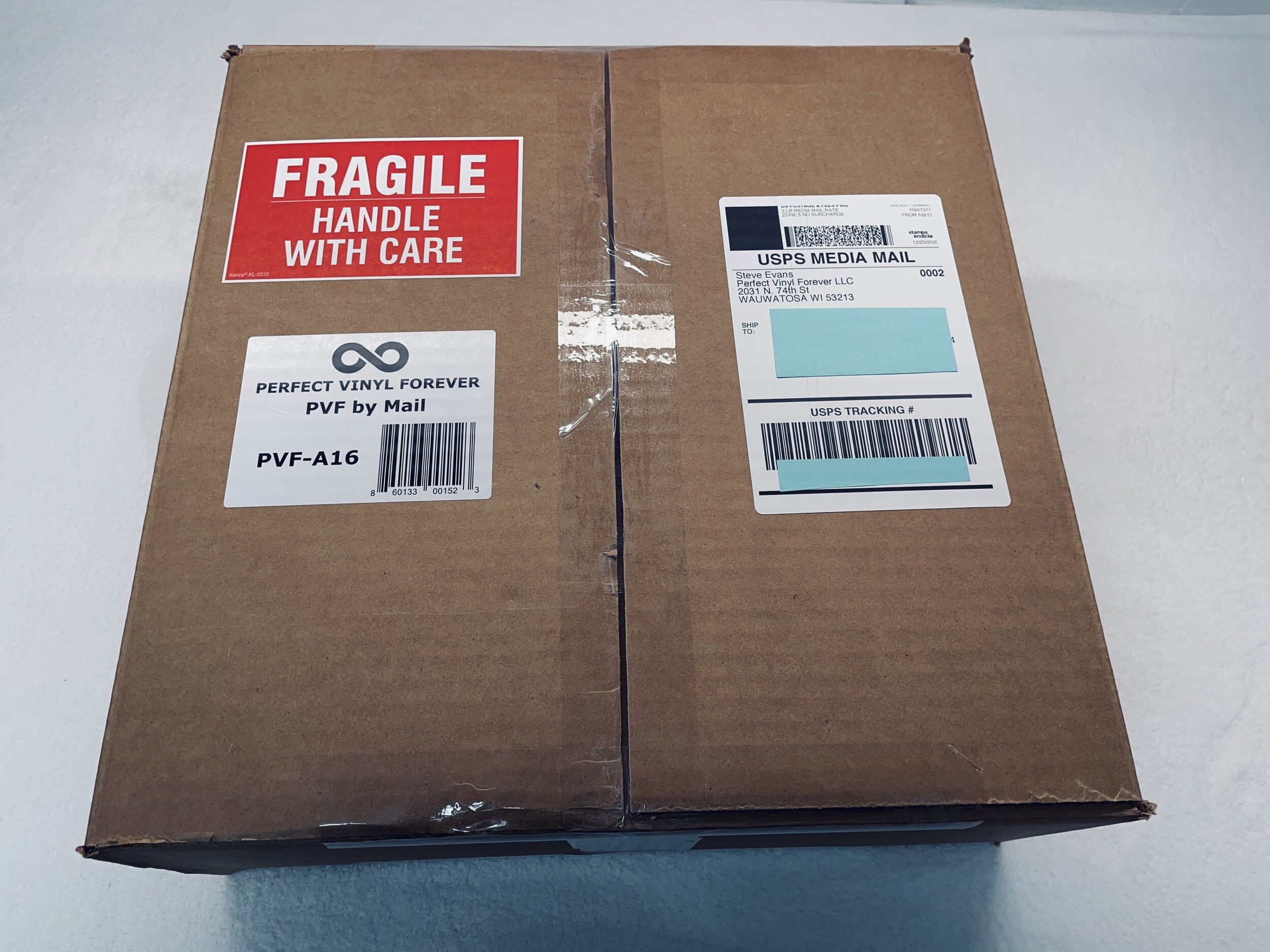
Our Mailer for 16 or 32 records arrives within 3-5 days (typically) of placing an order. All shipments are tracked. Shipping insurance levels are selectable when placing the order.
Step 2 - Open Box
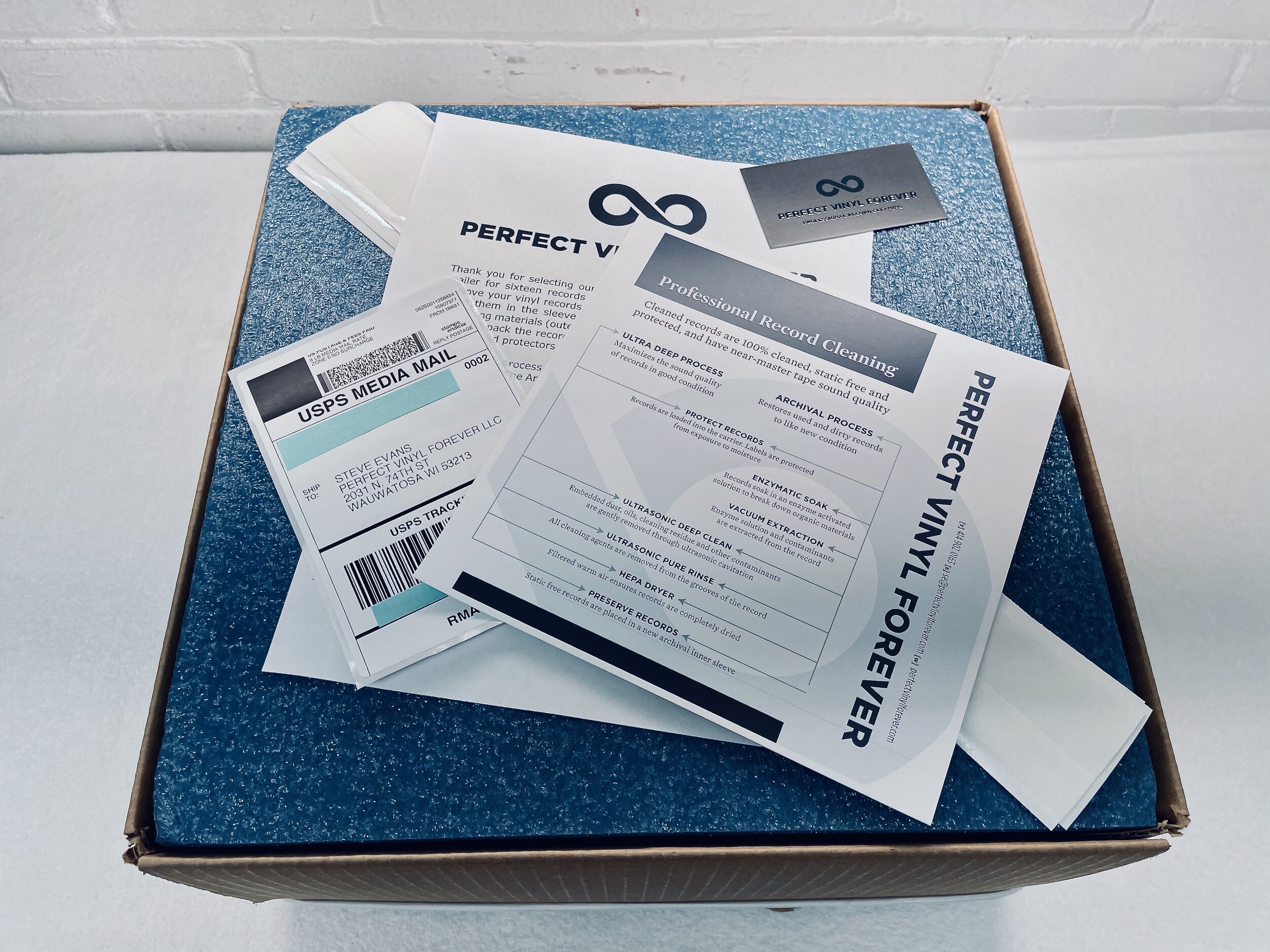
The mailer contains pre-paid return label, shipping tape strips, instructions, our process diagram and contact information.
Step 3 - Unpack Record Shipping Materials
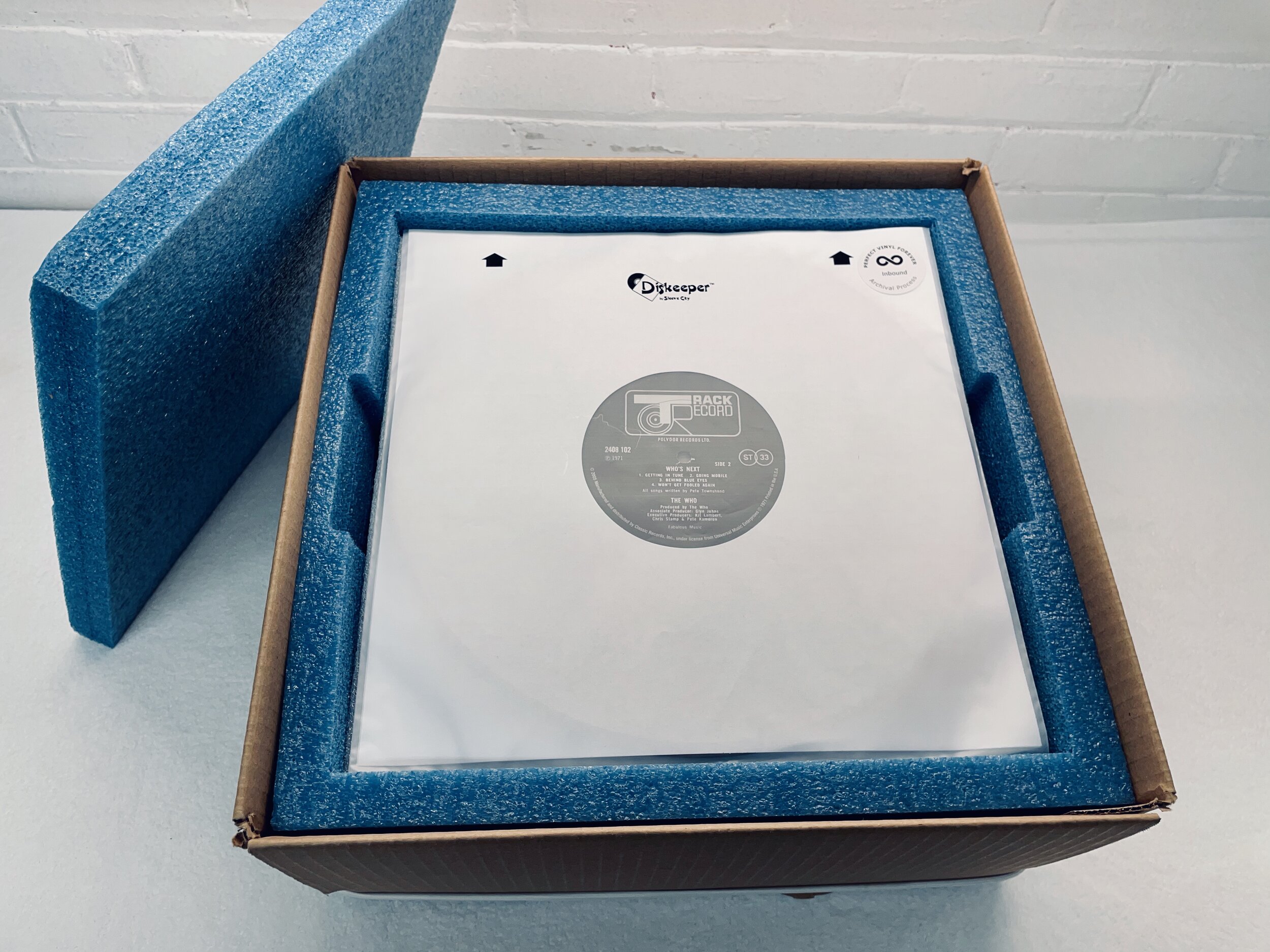
Within the mailer, you’ll find record protectors and inbound transport sleeves. Place your records in a transport sleeve then place it in the mailer. Separate the records with a record protector. Repeat 15 or 31 times…

Step 4 - Ready to ship
Once all of your records have been added to the mailer, place the top blue protector pad over the records. Use the included packaging tape strips to seal the package and place the pre-paid return label over the original shipping label. Hand the package to your postal worker and we’ll take care of the rest! Your records are cleaned and shipped back to you within five business days of arrival at PVF’s processing facility.
IT ALL STARTS WITH A GROOVE
For us analog aficionados, it is THE source. The alpha. A vinyl disc etched with a groove on each side. The beginning of the complicated signal path that transforms the invisible motion of a humble, minute vibrating stylus into rich, emotive, soul satisfying music.
There are many gain stages- points in the signal path where these minute vibrations grow in size, in amplitude. There are many passive highways- cables, wires, circuit board traces, and the only thing they have in common is they conduct electricity. There are many components- from the turntable, tonearm and cartridge through the phono pre-amp, line stage pre-amp and power amplifier to the loudspeakers.
You may have spent many years and countless dollars getting your hi-fi system to where it is today. Same with your vinyl record collection. You likely deliberated long and hard over each decision you made along the way. And it has paid off. When everything is just right and the music perfectly reflects your mood, or perhaps even creates it, the narcotic effect of the musical arts at their best washes over you. The payoff is immensely enjoyable and addictive. You listen deeply. You are moved. You desire more. Fleeting, perhaps, you wish for the next step...
But it all starts with a groove. A microgroove, as a matter of fact. And if the groove is not optimized, all your efforts for naught and your investments misspent. If you haven’t optimized your vinyl, you are gypping yourself, my friends. Cheating yourself from the very outset.
Optimize the source and the entire signal path springs to life. You will hear improvements. Not subtle “only golden ears need apply” stuff, but sublime, “waiting for this all my life” stuff. You will want to revisit every record in your library. You will have a fresh, new perspective on the music you once thought was so familiar, thought you knew inside out. Music you have listened to forever will reveal nuances you never heard before. Fair warning - you will want more. You will want your entire library to sound like this.
Perfect Vinyl Forever will help get you there. Even if you’ve diligently used various types of consumer record cleaning equipment, we will make a very noticeable improvement. For reasonable cost, we will employ the first purpose-built commercial record cleaning equipment and our exacting care in the process to optimize your vinyl. Our magic applies to brand new pressings, to well-loved and oft played treasures, and to “oh what the hell, it is only $2…” impulse buys.
I contend it is the lowest cost, highest value tweak you can make to your listening pleasure. Grab a few favorite albums - some new, some seasoned. Let us clean them and then evaluate the results for yourself. You will join the growing chorus of Perfect Vinyl Forever fans that has a hard time listening to non-PVF-optimized vinyl.
-STEVE EVANS, FOUNDER